We are pleased to present the Annual Comprehensive Financial Report for Bridgewater State University (BSU) for the fiscal year ending June 30, 2025.
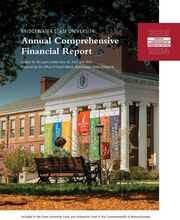
Download BSU's Annual Comprehensive Financial Report
2024-2025
The audit report conveys an unmodified opinion of the university’s financial statements for the fiscal year ended June 30, 2025. The link below pertains to the most recent Annual Report.
BSU’s financial position continues to be very strong. In FY25, the university realized an increase in its net position of $25.0 million, from $46.9 million in FY24 to $71.9 million in FY25. This growth was attributable to several factors, including:
- An increase in BSU’s state appropriation from SUCCESS and Fair Share funding;
- An increase in capital funding for improvements to Maxwell Library and the renovation of Burnell Hall;
- Growth federal, state and private grants;
- Strong enrollment growth that drove increases in tuition and fee revenues and increased residence hall occupancy and meal plan purchases; and
- Sound budget management across the entire university. For the past decade, BSU has systematically built its financial reserves, increasing them from approximately 4% of the operating budget in 2015 to greater than 10% in 2025. The university’s primary reserve ratio of 40.04% (minus the effects of GASB 68 pension and GASB 75 OPEB requirements) continues to meet industry benchmarks.
DISTINCTIONS
For the third consecutive year, BSU was ranked by The Wall Street Journal as one of America’s Best Colleges 2026, reflecting the strong return on investment we provide our students. BSU has also garnered several recognitions as a best place to work in education and higher education and as a USA Today Top Workplaces 2026. Bridgewater State continues to be ranked as one of the safest college campuses in the United States.
ENROLLMENT
Across higher education, enrollment remains a significant cause for concern. However, BSU is countering trends and outperforming its state university peers. Fall 2024 marked a return to enrollment growth and Fall 2025 saw accelerated growth, with an increase of 622 students or 6.4% to a total enrollment of 10,349 students. BSU set an all-time high with 1,767 new first-year students, an increase of 14% from 2024, and continues to see a strong rebound in new transfer students following years of declines.
There were several reasons for this surge in undergraduate admissions:
- The Bridgewater Commitment significantly enhanced the amount of local aid the university was providing students and set the university apart in a competitive and crowded higher education marketplace.
- The past year marked the third year of intensive work on high school sophomore/junior search and senior application cultivator campaigns, and the Fall 2025 class was the first where we had communicated with students for three years of their high school experience.
- The $1 million “Elevating Business” advertising campaign, while not directly targeted at prospective students, generated more than 75 million impressions.
- The sharp growth in community college enrollments, resulting from the state’s free community college initiative, likely helped support our growth in transfers.
BSU also saw very strong growth of 19% in the post-traditional population in both degree and non-degree programs. Graduate enrollment experienced modest growth, which was very encouraging, especially as the state did not renew its emergency teacher licensure grant that had driven enrollments the prior year.
Returning students represent the majority of our student body; retaining those students is thus critically important to enrollment. Our Division of Student Success, Equity and Diversity constantly develops innovative, data-centered strategies to close institutional performance gaps and enhance overall retention rates. BSU’s retention rates have consistently outperformed our national and state peers. Our first-to-second year retention rate for the Fall 2024 cohort increased 2
percent. BSU is also partnering with the Gardner Institute on an initiative to improve the first-year experience for students new to Bridgewater State University. In 2025-2026, BSU is focused on two priorities: enhancing the first-year experience through interdivisional collaboration and improving the student advising process.
There are challenges, including the onset of the decline in the number of high school graduates (the so-called demographic cliff); retraction in international enrollments, which will intensify competition in the domestic market; continuing questioning of the value of higher education; and threats to student financial aid emanating from the federal government.
The university’s Enrollment Management Committee (EMC) continues to update and revise its Strategic Enrollment Plan, always looking at new strategies and initiatives to generate enrollment growth.
INVESTMENTS IN DEFERRED MAINTENANCE/PHYSICAL PLANT
BSU completed a new Master Plan, its first new plan in more than a decade. The university continued to make major investments in deferred maintenance and capital improvements to the campus, including:
- Finalized renovations to 21 Park Terrace -entirely funded by the BSU Foundation - which opened as the new home of
the College of Graduate Studies in fall 2025 - Moving the College of Graduate Studies out of Maxwell Library will increase and modernize the space for the Academic
Achievement Center to support student success - Commenced renovations to Burnell Hall, which will provide a more modern home for the College of Education and
Health Sciences and help rationalize space utilization throughout campus - HVAC replacement and mold mitigation in Maxwell Library
- Construction of a portable aircraft hangar at BSU’s New Bedford Flight Training Center
- Major interior renovations in Tillinghast Hall
BSU hosted Governor Healey’s announcement of the BRIGHT Act authorizing more than $3 billion in public higher education capital investment to address deferred maintenance, modernization projects, and decarbonization goals. The state House of Representatives passed the bill in November 2025, and the Senate is expected to pass it in early 2026. The BRIGHT Act represents the first major capital bond bill for higher education in more than 15 years.
CAPITAL CAMPAIGN
BSU launched Without Exception: The Bridgewater Campaign for Success through Innovation, the university’s largest capital campaign in its history in June 2024, with the goal of increasing the university’s endowment to $100 million. In the past year, the university made major strides toward achieving that goal. As of June 30, 2025, the market value net assets reached $86.7 million. At the university’s 185th Anniversary Gala in November 2025, the university announced new gifts which, when realized in FY26, will help BSU surpass $92 million in its endowment (barring major market volatility).
INNOVATION
BSU continues to develop new academic programs aligned with market needs and workforce demands. BSU launched a bachelor’s degree in cybersecurity in Fall 2024 and a master’s degree in cybersecurity in Fall 2025. The bachelor’s program currently has nearly 250 students enrolled and the first year of the master’s program saw nearly 20 enrolled students. Two promising areas of program development include Health Professions and AI/Business Learning. BSU’s recently
signed MOU with the MGH Institute of Health Professions promises increased access to graduate degrees and pathways to employment in healthcare. Piloting certificates is a strategy the university is deploying to introduce potential new programs, e.g., data analytics. The university is also poised to launch an Individualized Studies BA program, which we expect will attract individuals who have earned college credit but not a degree.
BSU’s Center for Artificial Intelligence fosters human-centered, equitable, and responsible AI use aligned with the University’s mission and strategic goals. The Center provides leadership in integrating AI as a tool for creativity, critical thinking, and productivity, enabling our campus community to shape - rather than simply respond to - the future of work and learning in an AI-integrated world.
STUDENT EXPERIENCE
In Spring 2025, BSU administered its first campus climate survey in seven years. Overall, the survey results were very positive, with more than 88% of respondent feeling welcome and respected, nearly 80% feeling they belong at BSU, and nearly 72% feeling like a part of the BSU community. Feeling welcome, respected and a sense of belonging are strongly associated with student success and retention. Still, the survey data also revealed consistent patterns of
gaps across different student groups, such as students of color, transgender and non-binary students, and military and veteran students. BSU is now utilizing this data to develop interventions to address these gaps.
ECONOMIC IMPACT
BSU worked with FXM Associates in developing an economic report, quantifying the university’s impact locally, regionally and statewide. That report found that BSU is a major driver of the Massachusetts economy and that every dollar spent by BSU spurs $1.70 in economic impact. BSU generates:
- 2,949 jobs
- $225.5 million in labor earnings
- $401.7 million in economic activity (GDP)
- $5.2 million in state tax revenues
- $4.0 million in local tax revenues
BSU economic activity helps the Bridgewater and SE Massachusetts economy thrive, for example, through:
- $64.5 million in annual spending in Bridgewater and Plymouth County by nearly 10,000 BSU students
- $1.9 million spent with 187 Bridgewater businesses in 2024
- $18 million in estimated rent paid to Bridgewater landlords
BSU also makes direct and indirect contributions in the form of payments and delivery of services to the Town of Bridgewater, including hundreds of thousands of dollars supporting first responders, construction, Bridgewater- Raynham schools and community events. BSU donated 1,358 hours of community services in the past year through its Martin Richard Institute for Social Justice and has provided free cybersecurity services to help protect the town’s schools and infrastructure against malware, ransomware and phishing threats.
BUSINESS/PUBLIC POLICY STRATEGY
In the past year, the university began implementation of a significant strategy to enhance our presence on major business and public policy boards. Being “at the table” will help BSU forge connections with employers and create pathways to employment for our students and ensure BSU has a voice in influencing public policy. BSU has secured board seats with many influential organizations, including the Massachusetts Business Roundtable, the Massachusetts Taxpayers Foundation and South Shore Chamber of Commerce, and is exploring potential seats on the MassINC and Associated Industries of Massachusetts (AIM) boards.
The strength of Bridgewater’s financial position is a critical element in positioning the university to continue its upward trajectory, make investments that advance our strategic priorities, cope with emerging challenges and seize opportunities that position BSU for a future that we can control.
Sincerely,
Frederick W. Clark Jr., Esq. President