
The academic centers at Bridgewater State University enhance research and scholarship, foster community outreach and expand opportunities to obtain external funding. By supporting the scholarly and service interests of BSU’s faculty, librarians, staff and students, the centers make significant contributions to our local and regional communities as well as to the nation at large.
Our centers represent a sweeping range of interests, scholarship and expertise.
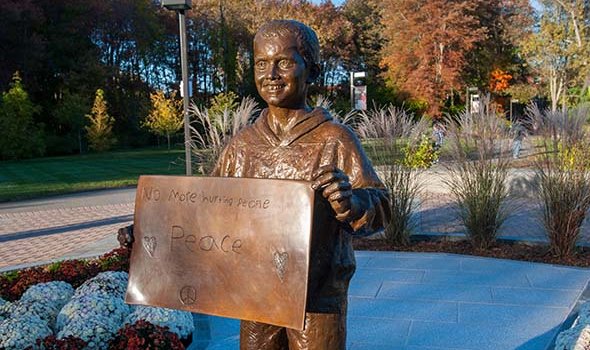
The Martin Richard Institute for Social Justice was created to build knowledge about social justice, to develop skills for advancing social justice through individual and collective action, and to serve as a catalyst for actualizing the university’s commitment to social justice.
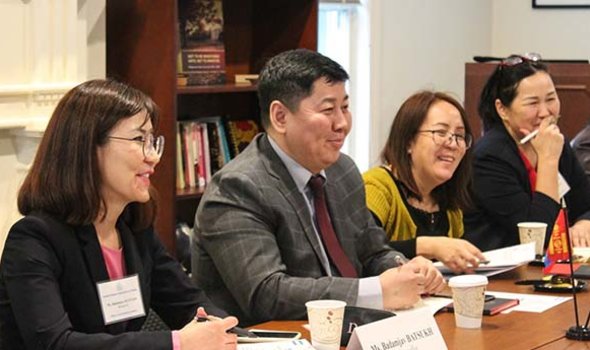
The Minnock Institute for Global Engagement is committed to creating and fostering a learning environment where students and faculty from other countries interact with Bridgewater students and faculty to help make the university a global campus. The Institute provides opportunities for academic enrichment, travel, research and community service.
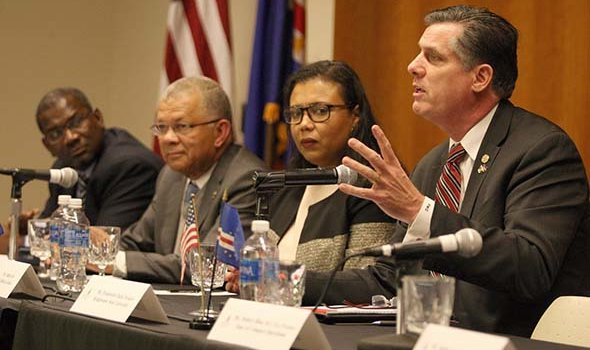
Through rigorous academic pursuits, community engagement and global partnerships, the Pedro Pires Institute for Cape Verdean Studies shares and celebrates the culture, language and history of Cape Verde, as one of the world's earliest Creole societies.

The Center for Educational Neuroscience Applications (CENA) is a Bridgewater State University initiative that sponsors invited speakers and workshops in order to explore and understand brain-behavior research that can inform our teaching and learning practices with the intention of creating an inward-facing resource to enhance the applications of neuroscience findings in education by our faculty, librarians and students. CENA houses the David A. Sousa ’60 Faculty Research and Development Fund which offers competitive grants for selected faculty/librarian member(s) to use toward research, publication, or professional development expenses in the area of neuroscience and its application to pedagogical theory and practice, a field of study extensively researched and written about by Dr. David Sousa.
Accordion Content
The Center for Artificial Intelligence at Bridgewater State University fosters human-centered, equitable, and responsible AI use aligned with the University's mission and strategic goals. The Center provides leadership in integrating AI as a tool for human creativity, critical thinking, and productivity, enabling our campus community to shape — rather than simply respond to — the future of work and learning in an AI-integrated world.
Our Vision
To be recognized as a national leader in transformative, people-centered AI innovation — responsibly harnessing Artificial Intelligence to expand opportunities and empower every learner and employee, setting a new standard for human-centered technological change within higher education.
Organized and led by faculty, librarians and staff, the mission of CARS is to foster the development of research, scholarship, and creative endeavors for faculty and librarians. CARS promotes individual, collaborative and interdisciplinary scholarship activities, and provides resources for the creation of knowledge that reflects and supports the strategic goals of the institution, when appropriate.
The mission of CASE is to promote and increase interest and literacy in science and mathematics amongst preK-12 students, pre-service and in-service teachers, and members of the university and regional communities. CASE aims to instill positive attitudes toward STEM disciplines in students of all ages, especially groups traditionally underrepresented in STEM careers; serve as a leader in exploring STEM education-related topics and the most effective pedagogy for their incorporation into the preK-12 classroom; and promote preK-12 STEM workforce development by recruiting, nurturing and training pre-service teachers to enter STEM careers.
CASE offers hands-on laboratory experiences for students, professional development and lending labs for in-service teachers, summer STEM programs for middle school students and access to Bridgewater State University's Observatory and Project EarthView's twenty-foot inflatable globe. In 2013, approximately 8,650 preK-12 students participated in CASE programs. These students came from 69 schools and 19 community organizations. Additionally, 196 undergraduate students, 520 teachers and more than 900 members of the community participated in CASE outreach programs, bringing the total number of participants to over 10,000. CASE programs also partnered with other University initiatives, including the Bridge and Footbridge Programs. For more information, please visit the CASE website.
BSU faculty, staff and students lead the following CASE programs.
CityLab is a biotechnology outreach program for teachers and students that aims to enhance science knowledge and enthusiasm through authentic laboratory experiences. Jenna Mendell, Assistant Professor of Biological Sciences, and Kim McCoy, Program Coordinator, run the CityLab program.
EarthView's twenty-foot hand-painted globe serves as a portable classroom, energizing geography programs throughout the region. James Hayes-Bohanan and Vernon Domingo, both Professors of Geography, oversee the EarthView program.
GreenLab aims to educate the BSU and regional communities about green chemistry and the impacts of chemicals on human and environmental health. Ed Brush, Professor of Chemical Sciences, oversees GreenLab.
The BSU Observatory hosts public and private viewing events, runs K-12 workshops, and provides resources for student research, astronomy courses, and service-learning. Jamie Kern, Observatory Manager, and Martina Arndt, Professor of Physics, oversee the Observatory.
Watershed Access Lab provides science education outreach programs and preK-12 teacher professional development focused on land use and water quality assessment. Kevin Curry, Professor of Biology, and Kim McCoy, Program Coordinator, lead watershed programs.
The Center for Entrepreneurship and Small Business (CESB) serves as a resource for those with an entrepreneurial mindset and small business owners at BSU and in the southeastern Massachusetts region. It helps students, faculty and staff from all areas within the university as well as people in the surrounding communities develop their business ideas into successful small businesses and grow existing small businesses. The CESB partners with on-campus and external organizations to establish a thriving network of successful entrepreneurs and small business owners who can serve as advisors and mentors to each other and to budding entrepreneurs and small business owners. In serving in these roles, the CESB promotes sustainable economic and social equity through economic and community development.
For more than 45 years, Bridgewater State University has sponsored Children's Physical Developmental Clinic (CPDC), a nationally recognized academic program that fosters professional development, service learning, and leadership development.
CPDC affords students from all majors a challenging opportunity to volunteer as clinicians and work with children and youth with disabilities, ages 18 months to 18 years. The aim of the clinic program is to improve the "total development" of children with disabilities by enhancing vital physical, motor, and aquatic skills and patterns. In addition, the program stresses the improvement of children's self-esteem by strengthening emotional-social aspects of their personalities through successful involvement in play, recreation, and sport activities.
More than a hundred students serve as clinicians and group leaders each semester, making the CPDC one of the largest student organizations on campus.
The Massachusetts Aggression Reduction Center (MARC) is an academic Center at BSU. MARC is staffed by faculty, students, office staff, and volunteers. We offer free and low-cost curricula, training, and programs focused on violence prevention to K-12 schools in the US and beyond. We emphasize positive social and emotional adjustment in children and young adults with a focus on bullying and cyberbullying, peer relationships, and digital wellness and civility. All our programs are evidence-based and prioritize a focus on prevention and practical strategies to build sustainable positive school environments. We include all stakeholders and center the voices of the students who inform our work.
Hundreds of students from all majors have been involved with the MARC service-learning program since 2004. In this course, students are trained to work with middle, high school, and college students to promote positive environments, in their schools and their digital lives. MARC also runs a rigorous research program, and students can get involved as research assistants or participants.
MARC is directed by Dr. Meghan McCoy, who has been at the Center since 2007. For more information, you can email Dr. McCoy at m2mccoy@bridgew.edu or call the office at 508.531.1784.