

There's a different energy to it when you're able to touch those pages and flip those pages. There's a certain reverence about it. It was definitely a dream come true and something not many scholars are able to do.
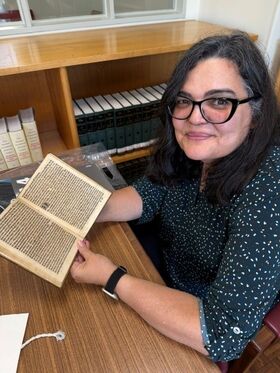
On a visit to Portugal's national library, Dr. Fernanda Ferreira found herself awestruck. She was turning the worn pages of a book that shaped the Portuguese language she studies and teaches.
Ferreira, who is a professor of global languages and literatures at Bridgewater State University, browsed the first Portuguese grammar book, Grammatica da lingoagem portuguesa, published by Fernão de Oliveira in 1536.
"There's a different energy to it when you're able to touch those pages and flip those pages," she said. "There's a certain reverence about it. It was definitely a dream come true and something not many scholars are able to do."
Ferreira viewed the book as part of the Luso-American Development Foundation's Short-Term Research Fellowship, which supports researchers’ visits to Portugal to access resources needed for their projects. She was one of 20 scholars selected for the 2026 fellowship from universities across the U.S., including Brown, Rice and Columbia.
"Bridgewater was in good company," she said. "I felt really proud of being Bridgewater's representative."
Ferreira is studying how the Portuguese language was established and how its grammar defines what is considered correct. She handled several early grammar books, which were especially important for creating a framework for the language. While they are digitized and available through microfiche, viewing the physical books allowed her to analyze their condition, weight and watermarks.
She was especially interested in how early Portuguese grammarians viewed the many regional dialects. Many of her BSU students speak an Azorean form of Portuguese and often feel that their dialect is inferior.
"The surprise for me was there wasn't anything in the grammars that I studied that stated Azorean Portuguese was bad," she said. "To the contrary, they indicated that there was a richness in these varieties.”
Instead, grammarians of the late 1500s focused on establishing Portuguese as a superior language and the country as an independent nation separate from Spain.
The project helps shape how Ferreira discusses the language with her students.
"I plan to say that Azorean Portuguese is Portuguese," she said. "There's a strong link between how Portuguese grammar was established and the different dialects of Portuguese. You should be really proud of this language."
Do you have a BSU story you'd like to share? Email stories@bridgew.edu.