

I was honored to be part of an event for an author who I admire and have been really interested to study. I think she has so much to teach us.
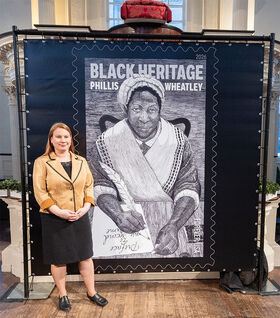
A stamp can be viewed as a soon-forgotten transactional item. But Dr. Emily Field hopes the U.S. Postal Service’s new Phillis Wheatley stamp sparks people’s curiosity.
The stamp, which is part of the USPS’s Black Heritage series, honors the first published African American author.
During the stamp unveiling, Field spoke to an audience gathered at the Old South Meeting House in Boston, the place where Wheatley was baptized and attended church services.
“I was honored to be part of an event for an author who I admire and have been really interested to study,” said Field, a BSU English and African American studies professor. “I think she has so much to teach us.”
The study of African American history and literature, she added, “is deeply enriching and ennobling to everybody.”
Field said she started researching Wheatley because her story is so compelling for BSU students. Born in West Africa and brought to Boston on a slave ship, Wheatley became a renowned colonial-era poet. As leaders such as Samuel Adams decried Great Britain’s heavy-handed rule that made colonists metaphorical slaves, Wheatley drew attention to the actual slaves living in the colonies. She published her poetry in 1773, the same year that she was freed from slavery.
“She is both a survivor of the Middle Passage (slave trade) and someone who was deeply read,” Field said. “She really changes the way students think about African American literary tradition and about slavery.”
Students in Field’s African American Literature 1 class respond to the joy and beauty in Wheatley’s poetry as she describes society and reflects on herself and God.
“The way she viewed the world despite her circumstances is the thing I’m most taking away from her,” said Rachel Moore, a secondary education and English major and psychology minor. “You can tell she was very appreciative of the world around her.”
Albert Dumont, ’27, also a secondary education and English major, appreciates Wheatley’s perseverance.
“She was taken at such a young age (from her parents) and sold into slavery, and yet she wrote such beautiful work,” he said. “She clearly is extremely well-educated in terms of religion and the classics.”
Albert and Rachel, who plan to become high school English teachers, credit Field with inspiring their future lessons. Albert appreciates the diverse views expressed during class as students share unique perspectives on literature.
Rachel hopes to teach her future students about Wheatley and other underrepresented authors. She praises the class for introducing her to the true breadth of American literature.
“In high school, the literature canon is old, white, rich men,” she said. “Bringing in people who do not fit that is so important because representation matters.”
Do you have a BSU story you'd like to share? Email stories@bridgew.edu.