This is a content holder for the one-button emergency notification system.

Additional details may be found at https://www.bridgew.edu/inclement-weather-campus-closed 

Free tuition and mandatory fees for families earning $125,000 or less. Learn about the Bridgewater Commitment »

Bachelor’s Degree in Economics

Turn data into decisions with an economics degree from BSU

A bachelor’s degree in economics from Bridgewater State University goes further than theory. It weaves together mathematics, social science, finance and communications to prepare you to think critically and solve problems. In the Department of Economics, you’ll explore timely topics like health economics, immigration and cryptoeconomics while building in-demand skills through econometrics, programming and hands-on research. You’ll learn in an engaged, student-centered environment with close faculty mentorship, discussion-driven courses, and opportunities to present your work. You’ll graduate with a changed perspective, practical skills, and the preparation needed for graduate studies or a career in a range of fields—from business and finance, to public service and beyond.
Economics Program Highlights

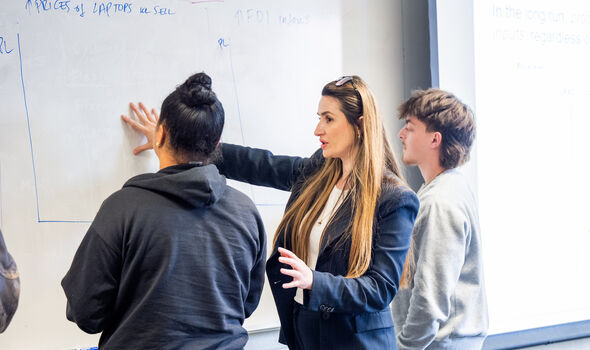
Dr. Albulene Kastrati standing in front of a white board with students showing them how to do something on the board

Involved faculty

Learn from expert faculty who mentor your growth. The BS in economics program emphasizes student-centered teaching, research-informed courses, and real-world experience across policy, analytics, finance and emerging technologies.

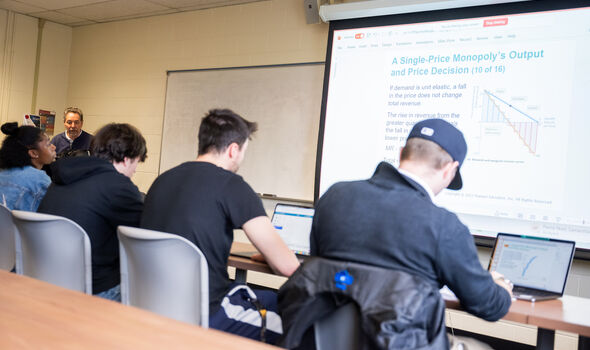
4 students sitting with laptops open at the front table of a classroom as Dr. Michael Jones teaches

Virtual Stata lab

Build career-ready data skills with a virtual Stata lab. Get free access to professional statistical software used for research, forecasting and analytics projects.

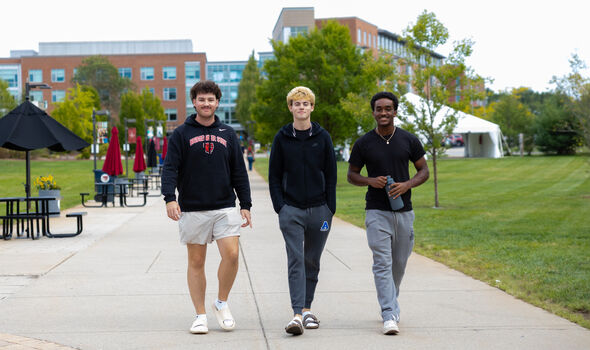
3 male students smile while walking together through University Park

An affordable economics degree

BSU offers a sensible pathway to earning your BS in economics. Whether you’re a Massachusetts resident or from out of state, we offer resources and financial support to help you pay for college.

Gain real-world experience

Pursue internships and directed study research with faculty mentorship. Students are also invited to serve on the curriculum committee and take part in Economics Department activities.

Get involved outside the classroom

Join Economics Club to participate in debates, activities, and organized trips that will enhance your bachelor’s in economics experience.

Connect to Boston and beyond

BSU is close to Boston, about 40 minutes away, giving you access to a major economic, financial and cultural hub with opportunities for internships, jobs and networking. The commuter rail stops right on campus, connecting Bridgewater to South Station.

Flexibility to learn on your schedule

Choose from face-to-face, synchronous and asynchronous (fully online) course offerings. The BS in economics program may be taken on Bridgewater’s main campus during the day, or you may pursue your degree at night.

Looking to transfer?

Did you know that 35% of BSU undergraduates enter as transfer students? Our dedicated Transfer Services staff will work with you to figure out how to transfer credits, which courses to take next, and how to settle in as a member of the BSU community.

Program of Study for Economics

The Department of Economics offers the foundation you need to strengthen your skills, along with courses that expand your outlook. Just a few of our BS in economics courses include:

  • Health Care Economics: Explore how economic thinking applies to health and health care markets. Using real-world examples and current debates, you’ll learn about the role of insurance, the impact of technology on cost, and gain an understanding of one of the world’s most complex industries.
  • Freakonomics: Look at everyday questions through an economic lens and challenge assumptions about why people do what they do. Topics include crime, parenting, corruption, and even cheating. You’ll practice connecting ideas from the text to real headlines and lived experience through lively, discussion-driven classes.
  • Programming for Economics: Get hands-on with the tools economists use to work with data. You’ll learn core workflows for cleaning, verifying, and modeling information, plus how to write and run code that supports analysis. By the end of this course, you’ll be more comfortable using computers as powerful problem-solving tools in research and business contexts.
  • Cryptoeconomics: Study blockchains and cryptocurrencies using foundational concepts from economics like trust, money, contracts, and organizational design. In a seminar-style format, you’ll analyze how decentralized systems work, where they succeed or fail, and what economic problems they’re trying to solve.
  • Econometrics: Learn how to answer economic questions with data. You’ll build skills in regression analysis, hypothesis testing, and model assumptions, then apply them using statistical software such as Stata. You’ll also learn how to diagnose common issues (like multicollinearity or heteroskedasticity) and interpret results clearly so you can turn datasets into conclusions you can explain and defend.
  • Immigration Economics: Examine why people migrate, how destinations are chosen, and what happens economically in sending and receiving communities. The course helps you develop a more grounded understanding of immigration’s economic drivers and consequences across policy and real-world outcomes.

Click any link below to reveal each program's course detail.

  • Loading...

Program details from 2025-2026 Undergraduate/Graduate Catalog

As a transfer student to BSU, I felt that the economics program was very welcoming and made it easy to transfer my credits. They have helped me to learn a lot about economics and to develop practical skills in things like research and statistics. The department offers many interesting classes, and I appreciate how they also allow students to pursue opportunities off the beaten path. Additionally, I have been a student member of the Economics Department Curriculum Committee, and I found the professors to be very thoughtful and responsive to student concerns.”

Gabriel Dionisi, '26
Economics, BS, and Computer Science, BS

Careers in Economics

What jobs can you get with an economics degree? An economics degree is a versatile tool for anyone interested in a career in business and finance, public policy, nonprofits, consulting and more. Some common career paths for economics majors include:

  • Banking operations or fraud analyst
  • Data analyst
  • Economic researcher
  • Financial analyst
  • Market research analyst
  • Policy or program analyst

BSU economics alumni work in finance, healthcare, education, government, defense and more, including:

  • ADP
  • Atkore
  • Beth Israel Deaconess Medical Center
  • Boston EMS
  • Boston Public Library
  • Boston University
  • Enterprise
  • EY Technologies
  • FAA
  • Fiserv
  • Lockheed Martin
  • NAVSEA
  • Rockland Trust
  • Santander Bank
  • Tufts University
  • Wrentham Public Schools

According to the U.S. Bureau of Labor Statistics, economists earn a median income of

$115K+

students

Continue your education beyond your bachelor's degree in economics

Your undergraduate economics degree can be a strong stepping stone to advanced study. Whether you’re interested in business, finance, public administration—or something else—BSU offers graduate degrees and certificates to help you build your next credential.