

BSU gives lots of opportunities to its students to explore different aspects of a field besides just classwork. It’s good to get experience outside, where there are a lot of different variables involved and you have to problem-solve.
Bobby Hohler, ’27, is unraveling secrets that lie just below the Earth’s surface, yet may have remained hidden for almost 200 years.
Bobby is part of an interdisciplinary team of Bridgewater State University researchers using ground-penetrating radar to document the location of graves in Ashland’s Village Burial Ground, which dates to 1828.
“BSU gives lots of opportunities to its students to explore different aspects of a field besides just classwork,” said Bobby, who is studying environmental geosciences. “It’s good to get experience outside, where there are a lot of different variables involved and you have to problem-solve.”
Team members spend field days pushing a radar that resembles a lawnmower. Much like mowing a lawn, they walk back and forth in a precise pattern to accurately cover their study area. The radar, which can gather data up to 10 feet down, sends high-frequency electromagnetic waves into the ground and measures the time it takes for the signal to bounce back. The team then looks for unnatural patterns that indicate grave shafts and original walking paths.
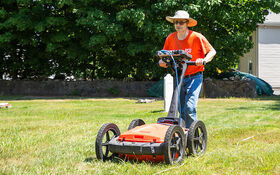
The research is part of a larger effort by the Ashland Historical Commission to revitalize the cemetery by removing dense brush and restoring weathered headstones. BSU’s work is essential to accurately mark the locations of graves and honor those who have passed away, said Catherine Rooney, a member of the commission’s Village Burial Ground Working Group.
“It’s wonderful,” Rooney said. “We were shocked that somebody would want to come up here and do this. … This would have cost us thousands of dollars, and we would have had to find a reputable and reliable crew to do it.”
Instead, commission member and emeritus BSU anthropology professor Curtiss Hoffman asked for assistance from his colleagues in geological sciences and anthropology.
“The archaeology program was set up specifically to be in service to municipal historical commissions and nonprofits,” said Dr. Michael Zimmerman, an associate professor of anthropology. “The idea of creating research projects which also serve communities can be very rewarding.”
Zimmerman and his colleagues even brought geology and anthropology classes to the cemetery to lend a hand.
“We’re trying to give as many of our students as possible research experience,” said Dr. Christine Brandon, an associate professor of geological sciences.
Brandon and Dr. Robin Dawson, an assistant professor, both represent geological sciences on the project.
Bobby, who is a summer volunteer, appreciates how it highlights the collaboration between geologists and archaeologists.
“It’s great to get out and expand (your horizons),” he said. “It’s been a good experience meeting a lot more people.”
Do you have a BSU story you'd like to share? Email stories@bridgew.edu.